
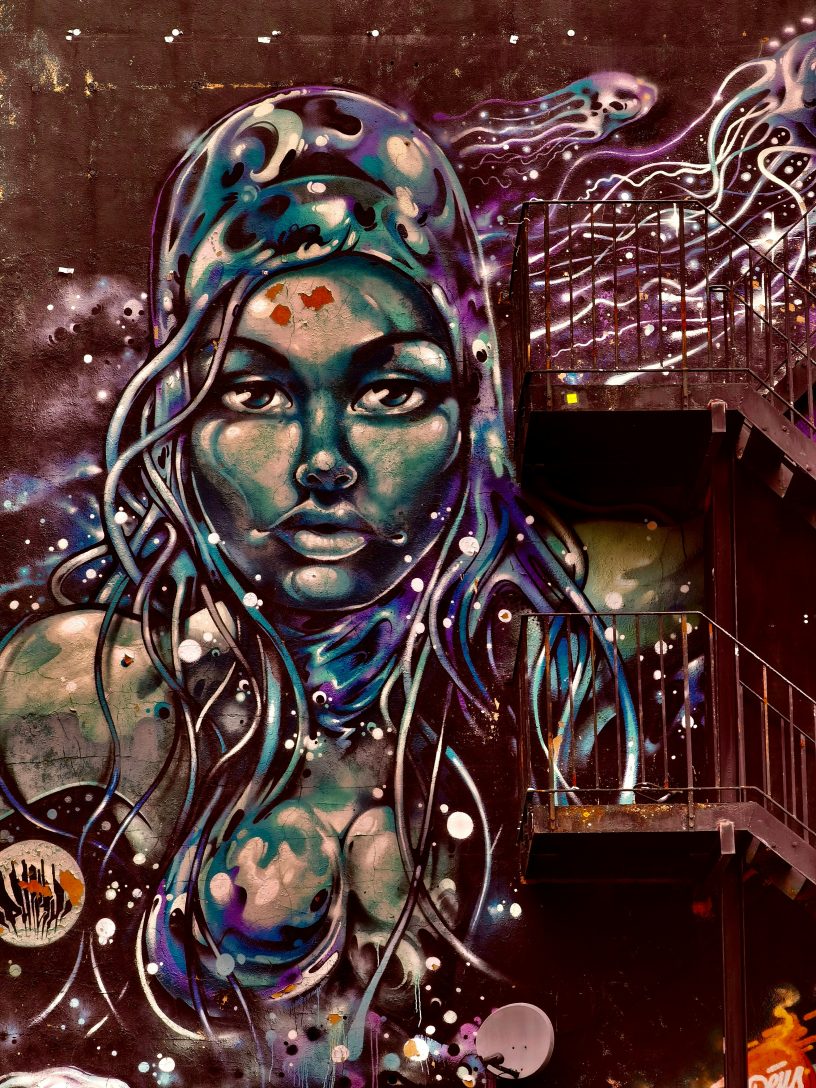

(Reimagined from a true-life story)
I see all. They have forgotten that I see all. My never-sleeping eyes roam the four corners of the earth, every day of the four market days. I never take a break. I have seen it all: the beginning, the middle, the end. What has been, what is yet to be, what can never be. Nothing excites me anymore. I see the sacrifices they bring, the goats they bleed, the hen with plucked feathers and eyes almost closed in death. Yet of all that I demand I take nothing but their devotion. My water carries their yams, their drinks, their sweets. My ụmụ-ọgbanje feast on what is left after the hungry amongst my children have ambushed and eaten most. I do not fault them. I see the hunger in the land, I see it reflected in their eyes.
I watch over them all, even the ones who swear they want nothing with me.
So it was, that on that day I was watching, looking for what will excite my ancient scales, when I saw him: a young man with strong legs running towards me. I could smell death around him. Ogbunaabalị had his claws deep in that one, ọ melọ na izu, ọ mee na ọnwa and there was nothing, no one that could pry him from his hands.
But it had been decades since I got any challenge, any request other than the mundane things that interest my children. And although that one was not mine, although he had never killed a ram nor bled a chicken for me, I wanted to see how his story would end, to see where his chi would lead him.
His screams tore through my grounds as he ran, his legs threatening to fail. He must have been running for a while. I could hear it from the earth, whispered to me by all that crawled upon it. He was headed my way. It had been ages since a mortal ran to me, since anyone sought refuge in my embrace.
‘Yes, come to me,’ I crooned, ‘come to the mother of all.’ Finally something to interest my immortal scales.
He leapt through the huddle in his path, his heart racing, pursuers hot on his heels. I spoke to Ikuku and she flared the clothes adorning my dwelling, putting my colours on full display. Red, for all the blood I have spilled, white for the peace I could offer. For I am nothing if not a double edged sword.
His chi answered, running into my home. ‘Please, please.’
He was safe. He was with me. I whispered so into his ears. But still he shivered, hiding behind the agwụ in my temple. I did not recognize him as mine, not from his mother, not from his father, not from the mother of his mother or from the mother of his father, not even from his whimpering chi. But now he was mine. He was home.
Commotion broke outside my dwelling, calling me away from my newest convict. I turned my eyes to the ones who had been in his pursuit. They were all my children. I knew them. They were molded from the womb of my earth, washed in the water of my blood. I had held them from birth.
One of them was speaking, saying words forbidden for mortals to utter. I knew that one, my prestigious ball python had staged a protest on the road leading into his father’s house the day he was born. I knew his father too—I had kept him safe during the war, blessing his land with water, aiding his farm with the harvest to take him and his pregnant wife through the war—and his father before him, a devout worshipper who never failed to kill a hen for me every Eke market day, the last of his peers to set foot in a church. But I also knew the father before that one, an ofeke who couldn’t go through the ritual to bring down his father’s chi nor acquire his own ikenga, and I could tell it was his essence that plagued the man.
‘Chairman, I can’t oo,’ a much younger man said, dropping the club with which he had pursued the fugitive. His perceived cowardice, a disguise for a wisdom greater than his age. I knew him too—carried within me the records of his genealogy. He had come through the ekwu ọmụmụ in his father’s house, no other way would his mother have conceived. My mbụya had visited her every full moon for the 10 moons she had carried him, ensuring that nothing happened to both mother and child.
Following his hesitation, I expected the rest to scatter. They all knew the law, they should have gone home by now. They had no business convening in front of my dwelling to await the one who ran to me.
Where was my priest? Where was the man who draped in white and bled animals over my streams every Eke?
The pursurers’ thoughts echoed through my ground, their fear seeping into my soil. Yes! They should be afraid. They were young men, men whose genitals were barely strong enough to carry ideal seeds. But their leader was much older. He more than all else should have heard from his father how I tore down the white man’s bridge and overran their boats. How I, refusing to be defined by seasons, continue to tear down the heavens and rain water and blood on all who dare defy me. How I spare none, not even my priests, one of whom I hung in my shrine, another whose stomach I bloated in judgement, and yet another, the priest of the very abode they defy, whom I will soon visit with death. How I have stayed and thrived where all else barely survived.
My waters raged and called for blood as he stood before my dwelling and gave commands. My pythons begged to have a go at him.
‘Who is this one?’ Mbụya asked, ‘this one who dares even think to defy you?’
‘You, the pillar that holds water in the sky overseeing the eternal separation of the heavens and the oceans,’ the pythons sang.
‘You who carry the responsibility of the universe, ensuring the world doesn’t overrun with water, drowning your children,’ the sacred fish echoed.
As the leader continued to bark orders, I heard the words he left unuttered. He did not care. His boys were different, the ones who were barely men. The hesitation in their skin leaked into my grounds, their fear evident more than ever. Yet they asked, ‘Chairman, are you sure?’ as though the man needed convincing, as though my name wasn’t enough to instill fear into his mind.
‘Go in there and drag him out,’ he ordered for the third time. Their fathers once swore that ife bịa na ịtọ, ọ tọ and so it was.
My grounds bled as the boys tore into my home and took that which was mine. His cries pierced my heart when he was taken, yet I watched from the heavens, uninvolved as he was beaten.
‘Ọkwa they will still leave him?’ a voice echoed through the grounds. It was that of a child, innocent in the way she believed in humanity, in the way she cried, ‘Ọkwa they will not kill him?’
No man should hold in his hands the power to end another. Yet they did just that. As his heart thrumped faintly, they hung a tire over his head and there, in my presence, before my dwelling where he ran to for protection, they set him ablaze. Ending him in the manner they thought to be at polar ends with me.
My waves called to me, begging to put out the flames, but I hissed at them to remain still. My pillars shook and the waters of the heaven stung my eyes. They wished to be let loose, to mourn that which had been stolen from us. But I held back, it was not yet time. But soon. Soon.
***
I sit in trial for the death of a man I am yet to kill. His chi has come before the deities to plead his case.
The Just One sits to pass judgement, flanked by Agbala, One of the celestial twins and Death himself.
Beside me shivers a rat with a burnt tail. My snakes dragged him from the flames before it fried his essence, and I have since taken him into my embrace, placing him within the ranks of my seeds. I have no plans for him; each day his path ripens with uncertainties.
On my other side, the earth fumes as she often does. She is draped in black mourning cloaks, but there are no tears in her eyes. My waters caress her ground and steam rises to the sky. Of us all, she is most beautiful. From her trees, our images are molded, from her sands, our devotees formed.
Yet she is most miserable, made so by her own children—humans whom in her very image were crafted. She should sit in judgement with the Just one, yet she chooses, as always, to sit with me. No one knows her better than I do. And there is none more devout to her cause. On days when her anger blazes hot, I cry from the heavens dripping my peace over her heat. On the days she calls for blood, I make it rain red. It’s our ritual, one that spans eons and today is no different.
The tortoise that speaks for my victim stands next to a seated Ekwensu—the bargainer, trickster deity, whose nature he wears—and Iyieliọba—the pantheon invoked to keep me in check. Here he argues his case. Here he fights for his right to remain.
Other deities have gathered to watch and take sides. To jest and make merry. My Ogwugwu is seated with her Udo—the duality consciousness—and their child Ngene. Enyinja laughs with Iyi-Obida over what I am sure has no bearing on the trial. And Njọkụ, as bored as ever, does not bother to hide his yawns.
The desperate chi begs and pleads, accuses and seduces, all to no avail. Now he cries, yet I remain unmoved.
‘What is my own? If a child lifts his father, do not the particles and articles in his father’s body fall and blind his eyes? And you, are you a child?’ I ask, ‘Tell me, chi ogbu mmadụ, where were you when your own desecrated my home?’
‘Is he not your own too?’ Anyanwụ, the fiery one of the celestial twins that is seldom seen together, asks.
‘Of course he is. He is my own and as his lord, his life is mine. Mine to give. Mine to take.’
‘Is he really yours when he has not poured libation to you in decades?’ The bargainer pounces.
I laugh. It is dry, like the earth on the days I withhold water. ‘You think that will stop me? You think that because he hasn’t poured libation to me in years, I cannot end the one who walks upon my land.’
‘Your land?’ He scoffs. ‘All is the earth’s and only she can decide who walks upon her and who returns to her embrace. To claim otherwise is to challenge Ala.’
‘Is that not the exact thing they did? Deny Ala the right to judge those who walk upon her.’
‘He was a thief!’ the desperate chi snaps.
‘Are we not all thieves in our own ways? Take a cup to my waters and drink. Tell us that you have never taken that which is not yours.’ I dare him, but he makes no move. ‘Times are hard. What a man has stolen, he has stolen to eat. Do we kill a man for trying to survive?’
‘Only Ala does he pour libations to, only she can judge him,’ Ekwensu claims, cunning as he was from the beginning.
‘Can we hear from the one upon whom this atrocity was committed?’ Agbala calls.
‘Tell me Ala, will you stand in the way of my judgement to the one who has stolen from me?’ I ask and the earth fumes.
‘No mortal should have the power to end the life of another. Not in peace. Not even in war.’
‘Eziokwu ka i kwuru! You speak nothing but the truth!’ Enyinja says, pausing her chit-chat, and Udo nods, ever my comrade.
Agbala turns to me. ‘Idemili, what is it you want from us?’
‘His blood runs through my water. His feet were planted on my soil before any other—first in the sac of his father, then in the womb of his mother. And today before the forces of nature, the gods of his fathers, the deities of his mother, and his very own chi, I demand his life.’
‘Will you kill that which you too will bury?’ Iyieliọba speaks for the first time.
‘The one he stole from me was also mine.’
Ekwensu stares pointedly at the scared rat that had since scurried away from me and is now chewing at a piece of fish I can swear he stole from a sleeping Njọkụ. ‘But he was not even your child.’
‘Yet he ran to me. He became mine the moment he chose me over death.’
Ogbunabalị scoffs. ‘Nobody ever chooses me, yet once all have passed through Ala, I am the next junction. I am the sweet relief all crave after a long day, the careless hunter that shoots down an animal at its prime.’ Then to Ekwensu, he asks, ‘what even is your own in this case?’
‘The head of the child whose life Idemili seeks is mine. It was my eager hands that welcomed his mother into this world.’
‘So it was you who taught him to desecrate my temple.’
‘Are you sure you do not just want to punish us for not pouring libation to you,’ the unruly chi chirps, his eyes lighting with a false sense of hope.
My waters rumble in response and the clouds pause for the sound of my voice. ‘You forget too quickly that I am a deity. I do not require permission to punish my people for sins long forgotten.’
‘Why do we sit here and bore ourselves?’ Njọkụ asks, rousing from his sleep, ‘if Idemili and her children have issues, let them settle amongst themselves. A child killed another child who had run to his mother for protection, is it not fair that the mother punishes the child?’
‘Should the mother in punishment now kill the child?’ Iyieliọba retorts, ‘Do we now throw away the child and the bathing water? Do we skin a child alive because he has rashes?’
‘Iyieliọba, do you also claim the killer?’ Ọnwa asks, having taken over from her sister, assuming her place amongst the judges.
‘His mother was birthed by one of my own,’ they answer, ‘In my temple was the mouth that breastfed him, breastfed. He is my akwa-nwa. Mine!’ They glare at me and I glare back.
For hours, we argue the fate of the killer, none conceding to the other. We argue until Anyanwụ returns, then leaves again. We argue, days spilling into weeks, as Ọnwa appears in her many phases. We argue until the earth tires of hearing our voices, until she calls to her twin and the sky responds, her verdict flashing across her clouds. Only then does the Just One speak, answering in thunder what is written in the heavens.
‘I am Amadịọhamma. The judgment that is fair and just to all. The one whose verdict is sure. Hear my words and hear justice. Listen to my verdict and learn fairness. A punishment must befit the crime. A murderer should not enjoy the luxuries afforded a thief. A thief should not meet the end due to a murderer.
But a thief is often never just one. Many do more than just steal. Welụ beyi malụ bem. If you steal my bread to eat, what then shall my children eat? Should we starve to feed your laziness?
Indeed the times are hard but are they not hard everywhere? Should we all turn to thieves then?
The punishment for a crime is decided by the wronged. But who dares take a goat out of the lion’s mouth? Who dares disrespect a deity and invade her home? An osu belongs to the deity to whom he has run, not to the people whom he has wronged.’ They pause.
‘Yet we plead. We do not demand. Rather we plead that Idemili shows grace and mercy to her children.’
The tortoise grows tails and fangs. He is a cat after all, a drenched one. The ability of my children to shed their skins and wear bodies alien to them never ceases to amaze me. Slowly he approaches me, whimpering, ‘Idemili, remember I am your own.’ His end is near. He knows it now.
I ignore him yet he keeps going, holding onto my pillars, ‘Have mercy, please do not drown us.’
For days he holds, at night he pleads, ‘Mercy! Idemili. Do not strangle your own.’
He begs and begs until I tire of his antics and kick him. ‘Be gone, cunning one! Do not give me ideas on how to torment my own.’
Not wanting to test the limit of my patience, he runs off and takes his place between his gods. Only then do I address the deities.
‘You have presided. I do not owe it to you or to mankind to uphold your ruling. I am Idemili, ala na azụ nwa. A mother to all who run to her. The refuge to the bereaved and a home to the mourning. But I am still Idemili, Ọ wepụlụ nwata ala na ọnụ mgbe afọ ejubeghị ya. I am the wicked one. I kill as I please and I demand retribution in blood.
But because of your plea, I will show mercy. His chi will live and I will not destroy his spirit. That is my decision.’
‘And we all respect it.’ The deities nod and the unfortunate chi scurries off to prepare for his last moments.
***
For days, the waters of the heavens will threaten to overrun the earth and I will spend my nights upholding my pillars. My children will bring sacrifices, some to thank me for the rain and others in supplication that I make it stop. I’ll see them drop the sacrifices, watch them place them dutifully on the street, fling them carelessly into the flood, or burn them on altars of stone.
Yet I’ll barely feel any. The few I’ll find will be remnants with gnaw marks on them. I will not need to ask, will not need to listen to the hissing of the python or await the vibration of the ground to know that I must find some use for the scampering rat before he tears through the sacrifice of my people and decides to rob other deities.
When I finally decide that it is finally time for my vengeance, I will grab my rat—now fat from overeating—and make my way down.
Everywhere will be dark. It will not yet be time for Anyanwụ to show herself, and Ọnwa will hide her face along with those of her billion children.
Eke ụmụnankwọ will be there, sitting beside a man’s head. She will be in mourning. Soon she will lose a child to the hands of another. I know her pain. I’ll sit next to her, my hands cuddling the head of my child whom I must ruin to avenge the wrong done to me. She will have done most of the work, planting in his head seeds about his kinsman and brother.
‘Why does he get everything while you get nothing?’ she’ll ask.
‘What does he have that you do not?’
Just a few thoughts, a few instigations from a few of their peers. It’ll be easy, for the man like most of my children, wears envy close to his chest like an amulet.
All that will remain is a final push and that is what I’ll offer. I’ll tell him how to end it but I have a lot of appreciation for creativity. My agwụ permits self expression and ingenuity.
When it is done, I’ll slitter out of his dream and watch him sleep.
As I make it out, the rat will slip from my hold, insisting instead on running ahead of me. I’ll watch him hop like a rabbit, unable to run and I’ll smile, having found a use for him.
I’ll sit in trial again, this time to answer for the death of a man I have killed, in the presence of his ancestors and the forces in his father’s household. Ala will sit next to me, her surface flooded with tears she refuses to absorb. A great atrocity has been committed against her. She’ll demand something stronger than water. Her womb will call for blood. Vengeance against the one who has killed his kin.
My victim’s ancestors will sit, surrounded by their Ikenga dike and their deities as they mourn. My weapon will have been more brutal than I anticipated.
I will ask mockingly, ‘Tell me, Ikenga dike, will you accept your son after what he has done to your other son?’
‘Just give us his chi,’ Ikenga will demand and I’ll laugh at his boldness.
‘Why will I do that?’
‘So that he will return. So that we will reincarnate our child.’ The ekwu ọmụmụ in his mother’s house will beg.
‘And if I don’t.’
‘You promised!’ Iyieliọba will yell.
I will laugh. ‘Tell me, Ikenga dike, how does it feel to watch your children battle each other to death? How does it feel to know that the one who killed your child is none other than your son.’
He will be quiet, all will be quiet. All but Ala whose tears refuse to dry. Even Amadịọha will say nothing. Their verdicts are laws to man not deities.
Finally I will say, ‘I am a deity, not an evil spirit. Here is your kinsman.’
Then I’ll call forth the chi my mmụọ has taken hostage since its owner died and watch it rush into the embrace of the ancestors. I’ll watch as they sniff to ensure it is theirs, laughing at their fruitless endeavors.
I’ll hold back my python, shut its mouth from whispering my nature. From announcing what all seem to have forgotten.
I am Idemili,
All carry my essence
I am of blood
I flow to things
And in them I leave myself.
I am of water
I am the sustainer of all that have life
I am everywhere, I am everything.
I say to the things that be not the same,
‘be the same,’
And they become the same
I was in the beginning
I am now
And only I will be in the end.
I will watch the Ikenga return to his people with the life force of a man as different from their son as Eke is from Afọ.
Soon his brother will birth a son, one who will bear marks in the exact place their kinsman delivered the killing blow to his brother. The people will dance. They will celebrate the reincarnation, praying to the deities and his chi that in this life he meets an end different from the one before. They won’t notice it at first, but eventually it will start to show: a missing meat from the pot of soup, a note missing from a wad of money, an item stolen for no reason at all.
They will try to help him, but no one can. Eventually, they will give up and leave him to his fate. For what better way to punish an intolerant child than putting him in the shoes of those he refuses to accommodate.
AUTHOR BIO
Uchechukwu Onyinyechukwu Onowu is a Nigerian writer passionate about exploring Africa’s history, culture, and spirituality. Through storytelling, she seeks to not only reflect the world but to also inspire meaningful dialogue and influence change. She lives in Lagos, Nigeria and her short stories have been published in Brittle Paper, Afritondo Publication, and Tales and Whispers. When she is not writing, she is listening to Beyoncé, Simi and Kendrick Lamar.
