

The Rise of Digital Activism in Africa
“The revolution will not be televised,” poet and musician Gil Scott-Heron famously declared in 1971, reminding audiences that real change is lived rather than passively consumed. More than 50 years later, Africa’s revolutions are not simply being watched, but they are being live streamed, recorded, shared, and organized in real time. More than a tool for political mobilization, digital activism has also become a powerful instrument for feminist organizations around the world.
In Africa, online spaces have created opportunities to challenge gender inequality, document gender-based violence, demand accountability, and tell stories that have long been ignored by traditional spaces. In many ways, Africa’s digital revolution has been as much about reclaiming voices as it has been about reclaiming power.
Back in the day, our ancestors used communication as a tool for connection and social progress. We are considered globally as the ‘cradle of civilization’ and our innovations throughout time have aided in our fight against colonization and imperialism. We have evolved in line with technological advancements and Western influence on African cultures. However, even with these changes, the continent has been able to make use of mass media to preserve communication and reach a wider network of individuals across Africa and beyond.
Today we have digital activism, which refers to the use of digital technologies and online platforms to advocate for social, political, economic, and environmental change. While activism in Africa has long existed through grassroots movements like underground newspapers, pamphlets, Pan-African congresses, and traditional word-of-mouth, the rise of the digital age has expanded the tools available to activist movements.
A research paper by Kargbo J.A. (2022) Diminishing African Traditional Systems of Communication: Perception of a Lis Profession strongly highlights the significance of communication in African communities and how traditional means of communication continue to persist over time. “The enduring nature of Africa’s traditional media of communication has made its people to subsist and stay relevant in the modern world in spite of the emergence of varied western media of communication…” He writes.
This endurance can be traced back to the expansion of internet access in the late 2000s and early 2010s which played a big role in the evolution of digital activism in Africa, beginning in North Africa’s Tunisia in response to the death of Mohamed Bouazizi by self-immolation. From Tunisia, the protests spread over to more countries in North Africa and the Middle East. This period was called the Arab Spring, and it demonstrated the potential of social media in mobilizing citizens and challenging political authority.
The next years continued to reflect the use of this potential, with several movements forming across the rest of the continent. In South Africa, the #FeesMustFall movement in 2015 used social media to organize protests on rising university tuition fees, and a year after that, the #MenAareTrash movement came to life in response to escalating rates of gender-based violence (GBV) and femicide.
It later spread internationally with similar feminist movements that gained momentum across Africa, including #MyDressMyChoice in Kenya, which protested violence against women and victim blaming, and #ShutItAllDown in Namibia, where young women mobilized online and offline to demand action against gender-based violence and femicide. These movements demonstrated that digital activism had evolved beyond political protest into a platform for challenging social norms and advocating for gender justice.
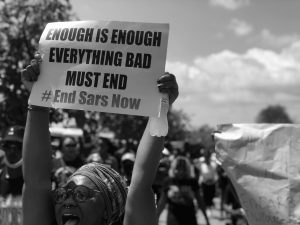
In Nigeria, the #EndSARS protests drew international attention to police brutality and the abuses committed by the Special Anti-Robbery Squad (SARS), with at least 69 deaths recorded according to Amnesty International. Nigerian psychologist, poet, and founder of Feeling Station, Sherif Ogundele, shared more insight on the psychological impact of the protest on Nigerian youth and the role digital activism played in spreading awareness and participation during October 2020.
“When the #EndSars protest escalated to the massacre at Lekki Toll Gate, social media was what enabled us to know what was going on because there were videos and livestreams; you could have sat at home from the beginning to the end of it and wouldn’t have missed anything.”
He described the crash of the economic landscape at the time and how it influenced the youth to fight for change.
“The #EndSars protest felt like a breaking point, a once-in-a-millennium chance, and it offered a sense of solidarity for once in our lives.”
He went on to further add that the protest was effective in its use of social media but noted that Africans need to understand that digital activism shouldn’t be bound indefinitely to the online sphere and individuals should be active on the grounds as well.
Women also played a defining role in sustaining the #EndSARS movement. The Feminist Coalition, a Nigerian women-led organization, coordinated fundraising efforts, provided legal aid, arranged medical assistance, supplied food and emergency relief to protesters, and communicated critical updates through digital platforms. Their work illustrated how feminist organizing had become central to one of Africa’s most influential digital movements, proving that digital activism is not only about raising awareness but also about building practical systems of care and solidarity.
Contributor(s): Mariam Hassan
