

Content Note: This story includes references to sexual abuse and contains descriptions of somewhat graphic violence.
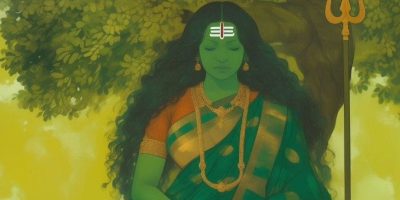
It was dusk as Kaalan hurried towards the sandbank, eager to finish his bath, pray at the kavu and get some rest. Having walked for several days, he longed for a good night’s sleep. Cheermba had sent him here for Neeli, the yakshi, haunting Kottiyoor. But as he neared the sandbank he saw the silhouette of a young woman seated expectantly and knew that sleep would have to wait. Gently he sat down near her at the water’s edge. Neeli smiled, soft curls framing her dark face; kohl-lined eyes and betel-juice stained lips. She handed him ubtan and oil for his bath.
“Neeli, isn’t it?” he asked softly.
She gestured wordlessly with her chin towards the ubtan and oil. Kaalan unhurriedly mixed the ubtan and oil and put it to his lips. He was about to drink it.
“Stop!”
Her soft laughter echoed. Two rows of perfect teeth, the canines fractionally longer; the imperfection enhanced her attractiveness. Kaalan sighed feeling the weight of his years. How many more Neelis? he wondered.
“I was expecting you,” she said gently.
“Kutty, I’m getting old and tired. I don’t know how much longer I can do this.”
“Don’t worry,” she consoled him, “Cheermba pothy will take care.”
“You are right, my child,” he muttered softly. “Let me bathe and worship, and we can be on our way. I don’t suppose I can stay and rest tonight.”
Neeli shook her head, smiling, “No.”
It was quite late when Kaalan returned from the kavu to the crossing where the palm trees stood. Neeli slipped out from the shadows and they walked shoulder to shoulder, on the narrow dirt path leading into the thicket.
“Now, tell me,” he said, after a long while.
“Let’s begin with what you’ve heard.”
“Not much,” he replied, “very little, sketchy, and no details.”
At Kottiyoor, there once lived Neeli, an extremely beautiful and intelligent young girl. She was killed by the local ruler. After her death, Neeli, now a yakshi, in the guise of a gorgeous young woman would offer oil and thali to passing travellers who came to bathe near the sandbank in the river. When they accepted, she would kill them and drink their blood. Once, Neeli appeared before Kalakkat Namboodiri, a mantravadi well versed in tantric rituals who immediately realized that she was a yakshi. Accepting the oil and thali, he mixed them together and gulped down the concoction.
“Thank you for the amruthu, ammae,” said the clever Namboodiri.
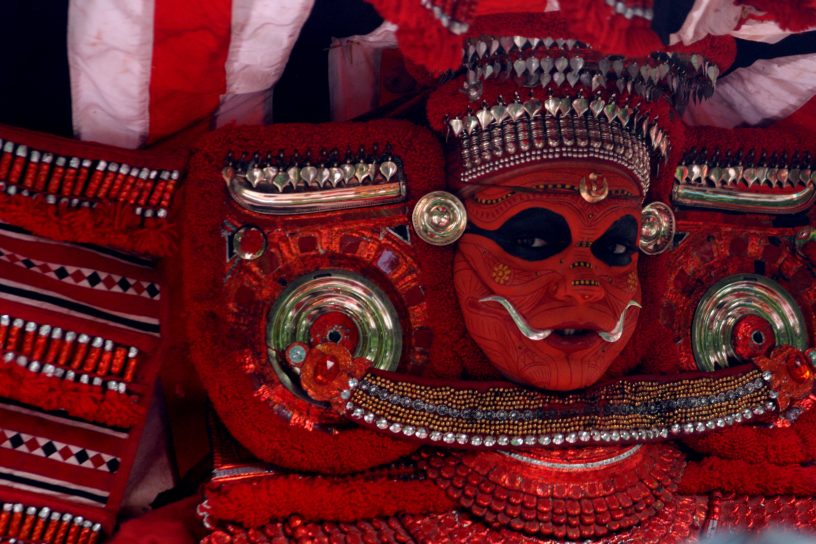
A deeply moved yakshi spared his life and decided to accompany him. He exorcised her of her yakshi-ness by nailing her head to a kanjiram tree thus transforming her into the goddess, Neeliyar Bhagavathi. The Namboodiri settled her in a beautiful sacred grove at Mangattuparambu where it is believed that tigers and cows lived peacefully together and the Neeliyar Bhagavathy teyyam was performed regularly to propitiate her.
Kaalan turned to Neeli and smiled. She began to laugh soundlessly, nodding in amusement. As they walked into the thicket, the chirping of cicadas drowned all sounds; the glowing tip of the pandham, that Kaalan held lit their path.
“Now, tell me what really happened,” he urged.
*****
Chaththan watched his little daughter Neeli as she played outside their tiny thatched mud-hut. She rhythmically babbled a song that she’d heard her mother, Kunji Kaali, sing, lisping the words incoherently as she picked up stones from the ground and arranged them in patterns. He recalled how long he and Kunji Kaali had hoped and prayed for a child. And then when they had almost resigned to a childless fate, in his fortieth year, Kunji Kaali, already thirty-six herself, became pregnant with Neeli. Years of hard labour in the fields had darkened their skins to ebony, the calluses on their feet had hardened to cracked leather and their hair was already turning grey. But Chaththan felt that Kunji Kaali had blossomed into the soft-skinned young woman he had married twenty years ago. He took care of her. Valiya tamburan, the senior landlord, in whose fields both toiled had been decent enough to ignore that Kunji Kaali did lighter work during her pregnancy as Chaththan made up by working extra hard.
Neeli burst into the world, dark and lusty throated, filling their quiet lives with uncontainable joy. Completely captivated, Chaththan would touch and kiss in wonder every perfect little toe and finger. His fellow serfs found his initial enthrallment amusing, but tired of it quickly and muttered under their breath, “As if no one else in the world has had babies.”
The older serfs warned him, “Don’t overdo it Chaththaa, she must grow up understanding that she is just a cherumi and not some tamburati.”
Chaththan nodded in agreement but continued to pamper Neeli, weaving toys from coconut leaves or chiseling them from twigs and firewood. As she grew, he made her little earrings and bangles out of leaves and flowers and wood. Neeli doted on her father always willing to be delighted with his hand-crafted toys and jewelry. She already understood that her waist chain would always be a frayed black thread with two shell beads; and that her jewelry would be made of coconut shells or leaves and driftwood; that she would never own gold waist chains, bangles or green stoned earrings set in gold like the little girl with kohl-lined eyes from valiya tamburan’s house.
Years went by and despite their poverty, Chaththan and Kunji Kaali never felt poor as Neeli pattered around the hut and the fields as they worked, filling their lives with abundant joy. As she grew she helped them with their work. Sitting outside his hovel Chaththan watched Neeli pluck wild greens for dinner, as the smells of Kunji Kaali cooking rice gruel and frying dried fish, wafted out. Content, he gazed into the distant horizon; paddy fields interspersed with small huts of other serfs like them all around as far as the eye could see. The sweat of their labour, and their love for the land they tilled, turned valiya tamburan’s paddy fields, periodically, into a lush emerald that ripened into swaths of gold. The paddy had just been sown, and in a few days, it would be time to transplant the seedlings.
At the far end was the thickly wooded grove. The annual teyyam festival transformed the kavu inside it for two nights into a magical space of fire torches and dancing goddesses. Cherumars would arrive from long distances and despite the extra preparatory work it was a break from the monotony of daily labour. Valiya tamburan’s permission would be sought and received along with some funds and material for conducting the festival.
Kunji Kaali watched Chaththan’s loving gaze rest on Neeli’s head and a sudden sense of dread froze the smile on her cracked lips. While Neeli slept inside the low thatched hut, she sat with her husband outside. She pulled out two crumpled betel leaves and a piece of betel nut from her waist cloth and handed them to Chaththan.
“Chaththaa…” she began, “Neeli is growing up fast, she’ll soon be a young woman. She’s only thirteen, but looks sixteen and I’ve seen the way young men look at her when she is working in the fields. We should get her married soon.”
Chaththan turned to her and smiled. “She is just a child; let her be, Kunji.”
Kunji Kaali’s unease persisted. “At least, go and talk to Cheeru’s parents and see what they think. Cheeru is a good boy. I’ve never seen him leering at Neeli, like some of the other boys. He can also read and count. If his parents agree, we can get them married, as soon as she comes of age.”
“Cheeru?” Chaththan asked in surprise. “So, you have given this thought then,” he smiled. “I like him too,” he agreed, “Cheeru is polite and calm, and a strong, hardworking young man. He will be a good match for our Neeli. Besides, his parents are gentle people, I’ll talk to them soon.”
Reassured, Kunji Kaali smiled. ‘Maybe I’m just imagining dangers and worrying unnecessarily?’ she thought.
A few years passed; Cheeru and Neeli’s wedding was fixed for after the harvest in a few months. They had sought valiya tamburan’s blessing. He had gifted them new clothes and a tiny piece of gold too. Neeli had grown into a beautiful young woman and worked hard with her parents in the fields. Cheeru too had grown into a strong young man and together they made a fine couple. One day elaya tamburan, valia tamburan’s son, who had returned home after some years of education away from home, came to oversee the work in the fields. His eyes fell on Neeli and he did not fail to see how beautiful she was. He began to come to the fields regularly and his eyes followed her as she worked. Neeli began to feel uncomfortable under his unrelenting gaze. Kunji Kaali tried to hide Neeli from his lascivious eyes but he continued to stalk her. Chaththan, Cheeru and other serfs noticed too and began to worry about this fatal attraction that would probably end badly. In order to avoid the young tamburan, Neeli stopped accompanying her parents to work.
Noticing that she no longer came to work in the fields, one afternoon, elaya tamburan went in search of her to her parents’ hovel. Finding her alone as expected, he attempted to force himself on her. But, she resisted fiercely. She pulled out a sickle from the thatched roof, and brandished it threateningly. Although her fierce resistance stunned him momentarily, he was blinded by rage. As a feudal landlord, he had considered Neeli mere chattel and assumed that he could do with her as he pleased. Her defiance infuriated him.
Shaking with fury and humiliation, he was heading home when he heard a commotion in the fields. They were looking for him. His father had suddenly collapsed and died. Despite getting caught up in the family emergency and the funeral rites, elaya tamburan was still smarting from her rejection. After the sixteenth day’s rites, the family decided to consult the kanisan, astrologer, to divine the reason for his father’s sudden death. The kanisan drew a kalam, placed cowrie shells and pronounced that something terrible had taken place in the tamburan’s estate. Unless amends were made, the family would suffer further calamities.
Among the serfs, a pall of gloom had descended at the news of valiya tamburan’s death. He had handled them with a distant kindness and grace but elaya tamburan seemed controlling and harsh. They wondered about his ability to manage the estate. Neeli decided that this was not a good time to tell anyone about what elaya tamburan had tried to do.
While tamburan’s family puzzled over the kanisan’s pronouncement, elaya tamburan secretly persuaded him through threats and bribes to declare publicly that future calamities could be averted only through narabali, human sacrifice. He then sent for Chaththan and informed him that the kanisan’s divination had indicated that the accursed Neeli whom elaya tamburan had caught red-handed with a man in their hovel had been the reason for his father’s sudden death. She had violated morality and the angered goddess could only be pacified with a human sacrifice. Neeli was to be sacrificed outside the Bhadrakali kavu early next morning and Chaththan himself must perform the sacrifice. Chaththan nearly passed out in horror on hearing this. He pleaded with elaya tamburan to ask the kanisan to find another remedy, but elaya tamburan was unmoved. Crazed with grief, Chaththan rushed to his hovel blabbering incoherently. But the news had already spread. Chaththan, Kunji Kaali, and Neeli spent a surreal sleepless night as if they were floating above their bodies, terrified and inconsolable. At dawn, Neeli was given a ritual bath in turmeric water. Dressed in the minimal finery put together for her wedding, Neeli’s family accompanied by other serfs reached the kavu. A crowd had gathered to witness the sacrifice. Chaththan’s legs buckled as he was handed the machete.
*****
Neeli looked down at the gathering. Chaththan and Kunji Kaali lay unconscious next to her lifeless body. Cheeru was kneeling beside her stoically holding back tears. The look of grim satisfaction on elaya tamburan’s face disappeared as his younger brother let out a piercing wail pointing in the direction of their palatial wooden mansion engulfed in flames. The crops in their homestead wilted and dried instantaneously. Howls of jackals and wolves rose to a crescendo as shadows of large birds of prey encircled the house.
In a flash Neeli realized that following her execution, the village would be beset with bad omens. People would afraid to go out of their homes. The tamburan’s family would become afflicted with psychological problems and mental illnesses. Finally, the kanisan would be invited again to divine the cause of these misfortunes. He would warn them that these were the results of Neeli’s wrath. A teyyam of Neeli, as Neeliyar Bhagavathy, would be pronounced as propitiation to calm her rage. Peace would be restored in the region only after her teyyam was performed.
Neeli turned and headed towards the sandbank to wait for Kaalan. He would escort her to Cheermba Pothy. Cheermba, the mother and protector of Neelis, would ensure that generations of the tamburan’s family would never forget and that Neeliyar Bhagavathy would be revered in the region for centuries to come.
Glossary
Kaalan – Kaalan meaning Time is derived from the Sanskrit word Kaal(a); in Hindu mythology this is also one of the names of the God of Death, whose key role is also the lord of justice.
Neeli – Neel means indigo/blue. In Indian myths, dark skinned gods and characters are referred to as ‘neel’ rather than dark- or brown-skinned.
Kavu – Sacred grove and also a small shrine.
Yakshi – In Kerala folklore, yakshis are shape-shifting beings with illusion creating possibilities. These blood thirsty spirits are believed to live in forests on palm trees preying on travellers. They are believed to be vengeful spirits of innocent and righteous women who were unjustly murdered. While Yakshi iconography projects non-threatening female sexuality and fecundity, literary representations are often demonic projecting the Indian males violent and paranoiac fears of menace on the Indian female. The yakshi thus carries all of these literary resonances in the cultural consciousness of Kerala as a figure of both erotic desire and mortal terror. However, yakshis also have other connotations as nature or guardian deities, etc. in Hindu, Buddhist and Jain literature.
Kutty – Child, Little one. A tender, non-gendered, and non-age specific way of addressing those who are younger in age.
Pothy – A linguistic nativization of the word Bhagavathy, (goddess) in North Malabar.
Thali – Ubtan
Mantravadi – Traditionally anyone who practices mantravadam (black or white magic), which is deeply rooted in Kerala’s history and culture. Some manas and illams (homes of Namboodiri Brahmins) are known for their long-standing traditions of mantravadam and associated spiritual practices such as astrology and Ayurveda.
Amruthu – also Amrit/Amrut or Amritham. Nectar of the Gods.
Ammae – inflection added to Amma (mother) when directly addressing her.
Kanjiram – Strychnos nux-vomica, the strychnine tree, also known as nux vomica, poison fruit, etc. is a deciduous tree native to India and Southeast Asia. Considered to contain medicinal properties according to Ayurveda, the seeds are a major source of the highly poisonous strychnine and brucine. Both Kanjiram and Palm trees are also associated with the yakshi myth in Kerala. It is believed that she lives atop palm trees and can be pacified into a gentle goddess when nailed to a kanjiram tree.
Teyyam – A ritual performance of North Malabar danced by men from ‘lowered’ castes in elaborate costumes, face and body painting, masks, headgear. They involve possession in which local deities or gods are embodied by the dancers. Teyyam combines elements of folk religion, ancient hero and ancestor worship, and local spirits, and is performed in kavus as well as kavus attached to homesteads (taravads).
Pandham – A stick with combustible material at one end, which can be used as a light source or to set something on fire. Fire torches have been used throughout history, and are still used in processions, and in many symbolic and religious events.
Valiya Tamburan – Elder feudal landlord, chieftain, or king.
Cherumi – Female gender of the word Cheruman, meaning agricultural serf.
Tamburati – Women from the tamburan’s (noble or royal) family. Female gender of the word tamburan.
Cherumar – Also Cherumakkal. Plural of the word Cheruman.
Elaya Tamburan – Younger feudal landlord, chieftain, or king.
Kanisan – Astrologer
Kalam – A horoscope drawn out for a method of divination (prashnam) used in Hindu astrology, particularly in Kerala. It involves analyzing a horoscope constructed for the specific moment a question is asked to provide answers and guidance.
AUTHOR BIO
Gita Jayaraj, a freelance writer and editor, and also ‘a hope-er, a pray-er, a magic bean buyer…’, is convinced that the best stories are found deep down the rabbit hole. You can find more of their works at https://gitajayaraj.wordpress.com/
