


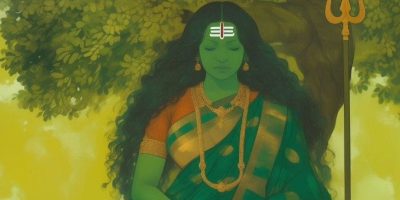
The drums were wrong that night — too fast, too hungry, the kind of drums that didn’t ask your body for permission before entering it, they simply walked through the front door of your chest. Dust climbed into the air in thick and red spirals and stuck to sweat-slick skin and settled between teeth, because sacred dust has no interest in falling. Women moved around the fire with the terrible precision of people who already knew the outcome of battle. Someone screamed, someone laughed, a goat bolted through the crowd, and the colonial soldiers standing at the edge of the clearing had stopped pretending bravery some time ago. One of them was vomiting quietly into the bushes, which Syotune considered admirably honest.
Syotune danced harder. Her ankles burned beneath the weight of bells, her chest opened and closed like something breaking itself apart voluntarily, and across the clearing a white officer stared at her with the specific fear that men reserved for things they cannot shoot their way through.
Good, she thought.
Then the earth beneath her feet shifted, not physically but spiritually, a deep wrongness moving under the soil like buried water changing direction, and a vibration cut through everything, through the drums and the fire and the colonial officers’ fragile dignity.
Bzzzt.
Syotune opened her eyes.
Her phone screen glowed in the darkness of her bedroom. PANEL DISCUSSION REMINDER. 6.30 PM. “REIMAGINING AFRICAN FEMINIST FUTURES.”
She placed the phone face down on her chest and stared at the ceiling with the full weight of a woman who had been yanked from a memory of ancestral war to be reminded about an event she agreed to attend on a day when her calendar was suspiciously empty and her judgement was correspondingly poor. She had been running from one version of this or another for over a century now.
In 1911, she had organized the Kenyan women of Kamba land around Kilumi — a sacred exorcism ritual, women in frenzied movement driving out evil spirits — because the British colonial administration qualified as evil. She had built an entire resistance movement around it, Ngai Ngoma (God’s Dance), refusing the hut taxes, the poll taxes, the theft of cattle and land, mobilizing women to spy on the men who had decided collaboration was survival.
The British had eventually called her a political threat, which was the first accurate thing they ever said about her, and exiled her for two years. She had escaped. She had come back. She was always coming back, and the world was always producing a new version of the same problem in progressively better lighting. Tonight that problem was a panel discussion with complimentary wine and pretentious aesthetics, and there was simply no dignity in any of it.
“Oh for fuck’s sake,” she said to no one, which is the only appropriate response to this kind of moment.
By five-thirty she already regretted agreeing to the event. This was the problem with letting one graduate student write a viral X thread about you. One minute you’re minding your own business buying groceries in peace and threatening Safaricom customer care with spiritual consequences because your internet has disappeared for the third time that week, and the next minute every decolonial feminist organization in East Africa has decided you are a “living archive” and would you please come speak at their thing. There will be food, and the food will be canapés the size of a thumbnail. She hated that phrase above all others. Living archive. As if she were a museum with breasts. As if the appropriate response to a woman’s continued existence was to put her behind glass and encourage people to take photographs.
The Uber driver kept glancing at her through the mirror while loudly playing a podcast hosted by two men who had discovered feminism during the pandemic and never emotionally recovered from the attention they received afterward. Men who spoke about gender with the breathless authority of people describing a country they had visited once and now claimed to understand completely. “And what African men need,” one of them announced, “is to reclaim softness.” Syotune rolled her eyes.
The hotel lobby smelled like expensive perfume and institutional funding, which is a very specific combination once you have learned to recognize it. Women in structured blazers stood beside pull-up banners discussing “intersectional community ecosystems” while balancing complimentary wine glasses and tiny samosas. Somewhere near the reception a white woman with locs was explaining restorative justice to a Kenyan woman old enough to remember independence, and the Kenyan woman’s face contained an entire library of things she was choosing not to say.
Syotune paused beside the decorative fountain near the entrance. The water smelled wrong — not dirty, but sick, the way a river smells when it’s being slowly murdered by development and the powers that be are insufficiently troubled to stop it. She frowned. There it was again, that strange pressure beneath the city, a distant song half-submerged beneath concrete and electrical wires. She had been hearing it for weeks now, usually late at night when Nairobi briefly stopped pretending sleep was optional.
The fountain bubbled softly. Something underneath it whispered.
She straightened and walked away. No. Absolutely not. She was not doing this tonight. Tonight she was collecting her appearance fee, eating mediocre chicken skewers, and leaving before someone asked her to mentor a startup.
“Professor Syotune!” A young volunteer hurried toward her, wearing the strained smile of someone navigating event management on no sleep and the distant hope of a good reference letter. “We’re so honoured to have you.”
Professor. Interesting. Last month another conference had introduced her as Mama Syotune, which had irritated her so deeply she considered summoning lightning indoors, and she had decided against it only because the venue deposit would have been complicated to recover. Indigenous African deities did not spend centuries maintaining excellent skin for strangers to start calling them Mama prematurely. There was an order to things.
“You’ll be on the keynote panel,” the volunteer continued breathlessly. “We’ve reserved seating for media interviews afterward if you’re available.”
“I’m not.”
“Oh. Okay. We also have a photowall installation inspired by indigenous resistance aesthetics.”
Indigenous resistance aesthetics. Syotune blinked slowly. Vocabulary was simply conquest in a different hat, and these people were very attached to their hats. “You people will eventually die from vocabulary,” she said, and the volunteer laughed nervously, uncertain whether this was a joke.
The ballroom looked exactly like every feminist conference ballroom Syotune had attended since 1968 — soft amber lighting and aggressively optimistic branding, a stage arrangement that communicated a deep commitment to the emotional power of beige, circular tables filled with women pretending not to network while visibly networking because opportunity doesn’t wait for the panel to conclude. At her table sat a wellness influencer who kept saying “healing journey” with a ferocity that could strip paint, a corporate executive there to discuss dismantling patriarchy; while wearing diamonds mined through at least three human rights violations Syotune could identify without research, and a young advocate who looked genuinely furious to be present in this particular room on this particular evening, which was the correct response to this particular room on this particular evening.
Syotune liked her immediately.
“You’re Syotune wa Kathuke,” the advocate whispered.
“No, I’m Lupita Nyong’o. We get confused for each other all the time.”
The girl snorted wine through her nose, which is the purest form of laughter the human body produces.
The moderator arrived with polished teeth and curated empathy, placing a hand dramatically over her chest the way people do when they want you to know they are feeling something without being specific about what. “It’s such an honour,” she said. “Your work has inspired generations.”
“My work?”
“Your activism.”
Ah. Activism. The word people used when they wanted to discuss war without acknowledging blood, struggle without acknowledging cost, a hundred years of something devastating reduced to a highlight reel suitable for a photowall. Before Syotune could say any of this, the moderator was already describing her resilience, which landed in Syotune’s chest the way it always did, heavy and wrong, the favourite word of people who benefitted from suffering but wanted to sound moved by it, who could say resilient with genuine warmth and somehow not notice that the system producing the suffering remained entirely intact and well-funded and was in many cases sponsoring this event.
Nothing on earth exhausted Syotune quite like watching struggle transformed into branding language. She had spent decades watching empires develop increasingly sophisticated methods for consuming resistance while remaining fundamentally unchanged — colonizers had once stolen land directly, and now corporations sponsored panel discussions about land acknowledgements while building luxury apartments on wetlands, and everyone agreed this represented progress. And perhaps it did, in the way that being stabbed with a very clean knife represents progress from a dirty one.
A waiter passed carrying glasses of water and the smell hit her immediately; metallic, rotting, a sharp scent of something older and wrong.
Syotune looked toward the ballroom floor. The whispering returned.
“You okay?” the advocate asked quietly.
“Yes,” Syotune said, which was a lie but an old one, the kind a woman repeats so many times it becomes second nature.
The panel began forty minutes late because apparently no gathering of Africans could occur without collectively disrespecting time itself. The moderator introduced everyone with exhausting enthusiasm, gesturing at “embodied liberation frameworks” and “decolonial praxis” in a tone suggesting these phrases contained meaning rather than performance. And then the corporate executive delivered ten uninterrupted minutes about empowering women through leadership pipelines, and the wellness influencer followed with an emotionally violent monologue about womb-centered entrepreneurship — a phrase that Syotune felt should carry a mandatory minimum sentence — and then the advocate spoke and immediately saved the entire evening by saying, plainly and without apology, “Most institutions discussing liberation are financially dependent on the systems producing the violence in the first place.”
Silence. Sharp and absolute. Several audience members shifted in their seats with the visible discomfort of people whose discomfort was precisely the point. Syotune smiled for the first time all evening.
“Oh,” she murmured. “She came to fight.”
The moderator recovered and turned to Syotune with the full force of her professional warmth deployed like a net. “Professor Syotune, as someone whose life and work embody resistance across generations, what do you think young African women need right now?”
The room turned toward her, already composing the tweet, already deciding which excerpt would perform best. She could predict every article quote forming in real time — ancient wisdom, radical softness, lessons from indigenous feminism — and someone would absolutely misuse the word “matriarchal” before the end of the night because someone always did.
The water beneath the hotel pulsed again. Stronger. A low pressure moved through the ballroom floor.
“What young women need,” she said carefully, “is rest.”
Several people nodded and typed furiously, which told her they had understood the word and missed the meaning entirely. Not branded self-care retreats with cucumber water and trauma-informed yoga instructors. Real rest. The kind that gets stolen by systems requiring women to survive everything beautifully and be grateful for the opportunity.
“And how do we empower African girls to reclaim that rest while navigating patriarchal structures?”
The question landed in the center of the room carrying the weight of a wrong question asked by the wrong people in the wrong building for the wrong reasons.
Underneath the hotel, the rivers shifted.
Not metaphorically or spiritually. Literally. The Nairobi River. The Ngong. The Mathare. Ancient waters forced underground, poisoned, redirected, buried beneath highways and development projects, corruption and concrete ambition, rivers that had been screaming in a register nobody at this conference had the equipment to hear, and she heard them now.
The room waited. Microphones hummed. Someone adjusted a bracelet. A waiter dropped cutlery in the distance and the sound rang through the ballroom like an accusation.
How do we empower African girls?
Syotune looked at the audience — at women with tired eyes performing for confidence, at women surviving institutions and building movements from WhatsApp groups and borrowed airtime, at women who had turned their suffering into productivity because nobody had ever presented them with an alternative, all of them surrounded by sponsors and branding and corporate feminism and development language and carefully curated radicalism, the entire apparatus of the extraction machine dressed in softer colours, better lighting and a commitment to inclusive language that cost nothing and changed less.
The rivers roared beneath the ballroom floor.
A wine glass trembled. The lights flickered. Nobody noticed except Syotune.
“Professor?” the moderator smiled, uncertainly.
Syotune didn’t answer because language had become too small for what the room required, and what was moving through her now was not the kind of thing that fits into a panel discussion answer or a social media graphic. She thought of women dancing beside firelight over a century earlier, their bodies speaking terror into colonial men who had believed until that moment that violence belonged exclusively to them. She thought of detention camps and protest marches and missing girls and dear rivers and women buried beneath systems sophisticated enough to call exploitation empowerment and elegant enough to host events about it in hotel ballrooms.
The lights failed.
Darkness swallowed the room completely, and in that darkness the drums arrived — not physical drums, because there were no drums in the room, but the sound was there regardless, deep and primal and entirely non negotiable, a sound that doesn’t ask for your participation and doesn’t wait for your agreement.
Syotune rose from her chair.
Her foot struck the hotel floor once, a single crack, and then the movement came through her — ancient rhythm slamming upward through carpet and marble and concrete foundations, through decades of careful management, strategic avoidance and the long practiced discipline of a woman who has spent considerable time pretending she is not what she is. This wasn’t culture for consumption. This was not a performance of heritage for an audience that would photograph it, post it and add it to their understanding of Africa as a place of meaningful ritual. This was invocation. War memory. Female rage carried physically across generations because there was nowhere else to put it that the people in power would have to look at directly.
She hadn’t danced Kilumi in roughly thirty years and yet her body remembered it how bodies remember pain; not gently, or with nostalgia, but with total and immediate conviction. It moved through her hips first, that ancient wrongness becoming rightness, her feet finding the pattern before her mind agreed to it. The sacred words came without searching for them, rising through her chest and out of her mouth in a language older than the building they were standing in, older than the city above these rivers, older than the colonial maps that had renamed everything including the rivers themselves. She was the instrument and the instrumentalist simultaneously, her body the bridge between what these women carried privately and what needed to be said out loud by something that had no interest in being polite about it.
Women gasped as the air pressure changed around them. Several dropped to their knees. The wellness influencer fainted, which Syotune privately considered was the most authentic thing she had done all evening. In the darkness, audience members began seeing things that were not visions exactly but memories that didn’t belong to them — grandmothers and marches and funerals and songs nearly erased by the patient, systematic work of people who understood that culture, killed early enough, girls carrying water and women screaming at soldiers and women laughing despite everything and women surviving impossible situations repeatedly, with a tenacity the moderator had called resilience and that Syotune knew by its real name, which was simply refusing.
The rivers answered. Beneath Nairobi, water slammed violently against its concrete prisons.
Women were sobbing in the darkness. Not delicately, not the careful crying of a panel discussion where tears are acceptable so long as they resolve into something hopeful, but full-bodied grief. One woman tore off her conference lanyard as if it was attempting to strangle her. Another whispered I’m so tired over and over again.
Good, Syotune thought fiercely. Tell the truth then. This is the only room that has given you the space to do it all evening, so you might as well use it.
The drums reached unbearable volume. And then stopped.
Silence crashed into the room and emergency lights flickered in weakly overhead, illuminating the specific wreckage of a gathering that had arrived expecting a panel discussion and received something significantly older and less manageable. Mascara streaked down expensive faces. One woman stared at her own hands as though meeting them for the first time. The moderator stood beside the podium in a condition of complete and genuine speechlessness, which was probably the most useful thing she had contributed to the event.
The advocate looked at Syotune with naked recognition; not admiration, which is about the person doing the looking, but recognition, which is about knowing what you are seeing, and the difference between those two things is the difference between being witnessed and being consumed.
Syotune picked up her handbag, adjusted her earrings and walked toward the exit.
In the lobby, the decorative fountain had overflowed slightly onto the marble floor, and hotel staff rushed around with towels looking deeply confused. The water smelled cleaner now; not healed, but awake.
Outside, Nairobi breathed hot and loud beneath electric light. Street vendors shouted. Matatus blared music. Somewhere nearby, a preacher threatened hellfire through a microphone with failing speakers, which Syotune found more spiritually honest than anything the ballroom had managed all evening.
Her phone vibrated — INVITATION TO SPEAK: PAN AFRICAN WOMEN’S LEADERSHIP SUMMIT — and then again — REQUEST FOR INTERVIEW — and then again, because the notification gods have neither shame nor boundaries and are apparently also not afraid of what they just witnessed.
“This is why the rivers are angry,” she muttered.
A boda boda rider pulled up beside her.
“Mama, where are you going?”
Mama. Again. Syotune climbed onto the motorcycle with the profound irritation of a woman who has survived colonialism and feminist conferences in the same body and is not in the mood for additional indignities.
They sped off into the noise and magnificent, exhausting life of a city built above rivers that had not yet finished speaking.
The city roared back at her. Underneath it, the water moved.
AUTHOR BIO
Wavinya Musyoka (she/her) is based in Machakos County, Kenya. She spends her days in the consultative work of building things and her nights writing her way through what all of it means – digging into her tribal history, into ancestry, into the particular strangeness of trading city life for a rural Kenyan town, and discovering that identity is not a settled thing but an ongoing argument. She writes personal essays on Substack and is working on a Kenyan fantasy series as R.M. Kioko.
